Microbiome-Skin Axis in 2026: Science-Backed Habits That Matter
Published February 28, 2026 • By AgelessWorld Editorial Team
Last updated February 28, 2026 • Reviewed by AgelessWorld Medical Review Board (Clinical content review)
6 min read
Fact-check method
This article is reviewed against primary citations, guidance statements, and known evidence limitations before publication and update.

Many people try expensive skin products before addressing gut and lifestyle basics. This guide is for readers who want practical, evidence-backed habits for clearer, more resilient skin and better systemic health.
Expected outcome: learn a realistic protocol that supports microbiome diversity and reduces avoidable inflammatory burden.
Evidence Breakdown
High confidence
- Low dietary fiber is associated with poorer microbiome diversity.
- Barrier-disruptive skin routines can worsen inflammation and sensitivity.
- Sleep and stress load influence inflammatory skin outcomes.
Medium confidence
- Fermented foods can improve microbial diversity markers in many adults.
- Some probiotic strains may help specific skin outcomes in selected groups.
Low confidence
- One-size-fits-all microbiome supplements for everyone.
- Overconfident claims that “healing gut always cures skin.”
Practical Protocol and Checklist

Daily protocol
- Target 25–35g fiber from whole foods.
- Include 1 fermented food serving if tolerated.
- Avoid routine over-exfoliation; prioritize barrier repair.
- Sleep 7–9 hours and maintain timing consistency.
- Reduce ultra-processed snack frequency.
Weekly protocol
- Track 3 indicators: bowel regularity, skin irritation episodes, and sleep consistency.
- Add one new plant food each week to increase diversity.
- Keep skincare active stack minimal to identify irritants.
Assess behavior patterns with the Microbiome Quiz and pair findings with basic food/sleep tracking.
Risks and Contraindications
- Sudden fiber jumps can cause GI discomfort; increase gradually.
- Fermented foods may not suit all GI conditions.
- Aggressive elimination diets can reduce nutrient adequacy.
Who Should Talk to a Clinician First
- Persistent GI pain, blood in stool, or unintentional weight loss.
- Severe eczema, recurrent rashes, or suspected contact dermatitis.
- Immunocompromised status before using live microbial supplements.
Advertisement
The Gut-Skin Axis: What the Evidence Actually Shows
The gut-skin axis refers to bidirectional communication pathways between the gastrointestinal microbiome and skin health. This communication occurs through several mechanisms: systemic inflammation, immune system modulation, short-chain fatty acid (SCFA) production, and metabolite signaling.
When gut microbiome diversity is low — driven by low-fiber diets, antibiotic use, poor sleep, or chronic stress — pro-inflammatory pathways can become dysregulated. This does not automatically cause a skin condition, but it creates a systemic environment that makes skin inflammation more likely and skin barrier function harder to maintain.
The conditions with the most consistent gut-skin association in the literature include:
- Acne vulgaris — associations between gut dysbiosis and sebaceous gland inflammation.
- Atopic dermatitis (eczema) — probiotic interventions show meaningful reduction in some pediatric and adult populations.
- Rosacea — gut motility dysfunction and small intestinal bacterial overgrowth (SIBO) associations observed in multiple studies.
- Psoriasis — systemic inflammatory overlap between gut microbiome composition and psoriatic flares.
These associations do not establish that fixing gut health directly cures these conditions. They suggest that gut and skin health share inflammatory pathways, and supporting both simultaneously is reasonable.
Fiber: The Foundation of Microbiome Health
Dietary fiber is the primary fuel source for beneficial gut bacteria. Without adequate fiber, microbial diversity declines, short-chain fatty acid production drops, and gut barrier integrity weakens over time.
Most adults in Western diets consume 10–15g of fiber per day — roughly half the recommended 25–38g. The gap is significant and behavioral.
Practical fiber hierarchy (prioritize whole food sources):
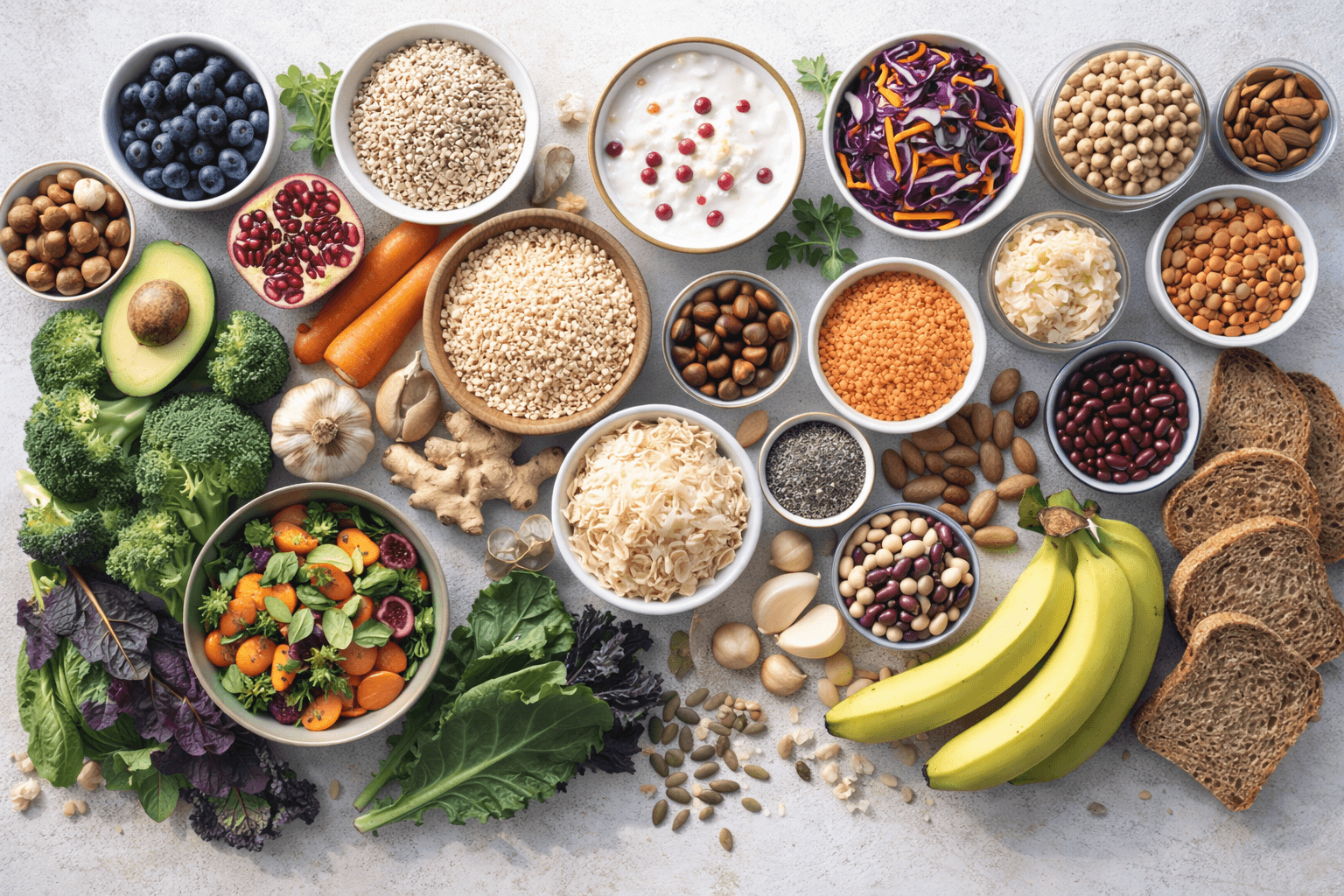
- Legumes — lentils, chickpeas, black beans (6–9g per half-cup cooked). The highest fiber density per calorie of any food category.
- Vegetables — especially cruciferous (broccoli, cauliflower), artichokes, and green peas.
- Whole grains — oats, barley, and quinoa provide soluble fiber (beta-glucan) with additional anti-inflammatory properties.
- Fruit — berries, apples, and pears with skin are practical and broadly well-tolerated.
- Nuts and seeds — flaxseed, chia, almonds. Adds fiber alongside anti-inflammatory fats.
The goal is not a perfect diet — it is consistent exposure to a wide range of plant foods. Diversity of plant species consumed per week is a better proxy for microbiome health than any single "superfood."
The Skin Barrier: Where Microbiome and Topicals Intersect
The skin has its own microbiome — a community of bacteria, fungi, and other microorganisms that live on and within the skin's surface layers. A healthy skin microbiome supports:
- Barrier integrity (reducing transepidermal water loss).
- Resistance to pathogenic bacteria (such as S. aureus in eczema-prone skin).
- pH regulation, which affects antimicrobial peptide function.
Many popular skincare actives — especially exfoliants, strong retinoids, and surfactant-heavy cleansers — can disrupt skin microbiome balance when overused. The 2026 shift in dermatology toward "skin-microbiome-friendly" formulations reflects this understanding.
Practical implications:
- Limit exfoliation to 2–3x per week at most, unless clinically directed.
- Avoid harsh sulfate cleansers on the face; use pH-balanced, gentle surfactants.
- Moisturize consistently to support barrier repair, especially after active treatments.
- Introduce actives gradually — not multiple new products simultaneously.
Sleep, Stress, and the Inflammatory Skin-Gut Connection
Sleep deprivation and chronic psychological stress both increase cortisol and pro-inflammatory cytokines. These systemic effects manifest in the gut (increased permeability, reduced motility) and the skin (increased sebum production, reduced barrier function, slower wound healing).
This is why addressing gut and skin health requires more than dietary changes. Sleep consistency — targeting 7–9 hours with regular timing — is often the missing variable when diet interventions produce inconsistent skin outcomes.
For a structured approach to sleep optimization, the Sleep Optimizer tool provides practical habit recommendations based on your current sleep patterns.
Evidence Limitations
Microbiome research is advancing quickly, but individual response variability is large. Many studies are association-based, and intervention results may not generalize across age, baseline diet, and medication history.
Related Reading
- Top 8 Skincare Trends for 2026
- Stress, Cortisol, and Skin Aging: A Recovery Protocol
- Policy context: Editorial Policy and Disclaimer
Sources & Citations
- Sonnenburg ED, Sonnenburg JL. Diet-microbiome interactions.
- Leeming ER et al. Plant diversity and microbiome associations.
- Wastyk HC et al. Fermented foods and microbiome diversity trial data.
- Byrd AL et al. Skin microbiome and barrier function reviews.
- Salem I et al. Gut-skin axis and inflammatory disease review.
- NIH resources on dietary fiber and gut health.
- AAD guidance on gentle skincare and barrier care.
- Clinical review papers on probiotics and dermatologic outcomes.
This article is for educational purposes only and does not provide medical advice.
Frequently Asked Questions
How We Choose Sources
We prioritize peer-reviewed human evidence first, major public-health guidance second, and use trend reports only as supporting context. Read our Editorial Policy for full methodology.
Written by AgelessWorld Editorial Team
Reviewed by: AgelessWorld Medical Review Board
Publisher: inboundflow.in
Last reviewed/updated: February 28, 2026
Editorial PolicyAdvertising PolicyDisclaimer
Not medical advice. Consult a qualified clinician for diagnosis or treatment decisions.
Advertisement