Strength Training for Healthspan: Anti-Aging Basics That Actually Matter
Published February 28, 2026 • By AgelessWorld Editorial Team
Last updated February 28, 2026 • Reviewed by AgelessWorld Medical Review Board (Clinical content review)
6 min read
Fact-check method
This article is reviewed against primary citations, guidance statements, and known evidence limitations before publication and update.

Affiliate Disclosure: Some product links in this article are affiliate links. We earn a small commission if you purchase at no extra cost to you. We only recommend products we believe in. See our Advertising Policy.
Aging discussions often overfocus on niche interventions while underweighting the basics of muscle maintenance. This guide is for adults who want practical strength training that supports long-term function, metabolism, and resilience.
Expected outcome: a realistic weekly framework that improves strength and recovery without overtraining.
Evidence Breakdown
High confidence
- Resistance training improves muscle strength and physical function across age groups.
- Preserving lean mass supports insulin sensitivity and metabolic health.
- Progressive overload with adequate recovery produces reliable adaptation.
Medium confidence
- Training frequency and split preference can vary while still delivering meaningful outcomes.
- Combined aerobic + resistance approaches may improve cardiometabolic markers more than either alone for some populations.
Low confidence
- One “perfect” split or protocol for all individuals.
- Claims that specific supplements can replace foundational training quality.
Practical Protocol and Checklist

Weekly protocol (starter)
- 2–3 full-body sessions per week.
- 4–6 movement patterns: squat, hinge, push, pull, carry, optional single-leg.
- 2–4 working sets per movement, moderate intensity.
- 1–2 reps in reserve on most sets.
- 7–9 hours sleep and protein adequacy for recovery.
Progress checklist
- Add small load/reps every 1–2 weeks when form remains stable.
- Track one performance marker per movement.
- Deload when fatigue accumulates for multiple weeks.
Combine this with the Biological Age Calculator to monitor broader lifestyle trends.
Risks and Contraindications
- Technique breakdown under fatigue increases injury risk.
- Excess volume with poor sleep/nutrition can degrade recovery.
- Pain should not be treated as normal progression.
Who Should Talk to a Clinician First
- Recent cardiac events or uncontrolled hypertension.
- Significant joint pain, neurological symptoms, or post-surgical status.
- Any condition where exercise intensity needs medical clearance.
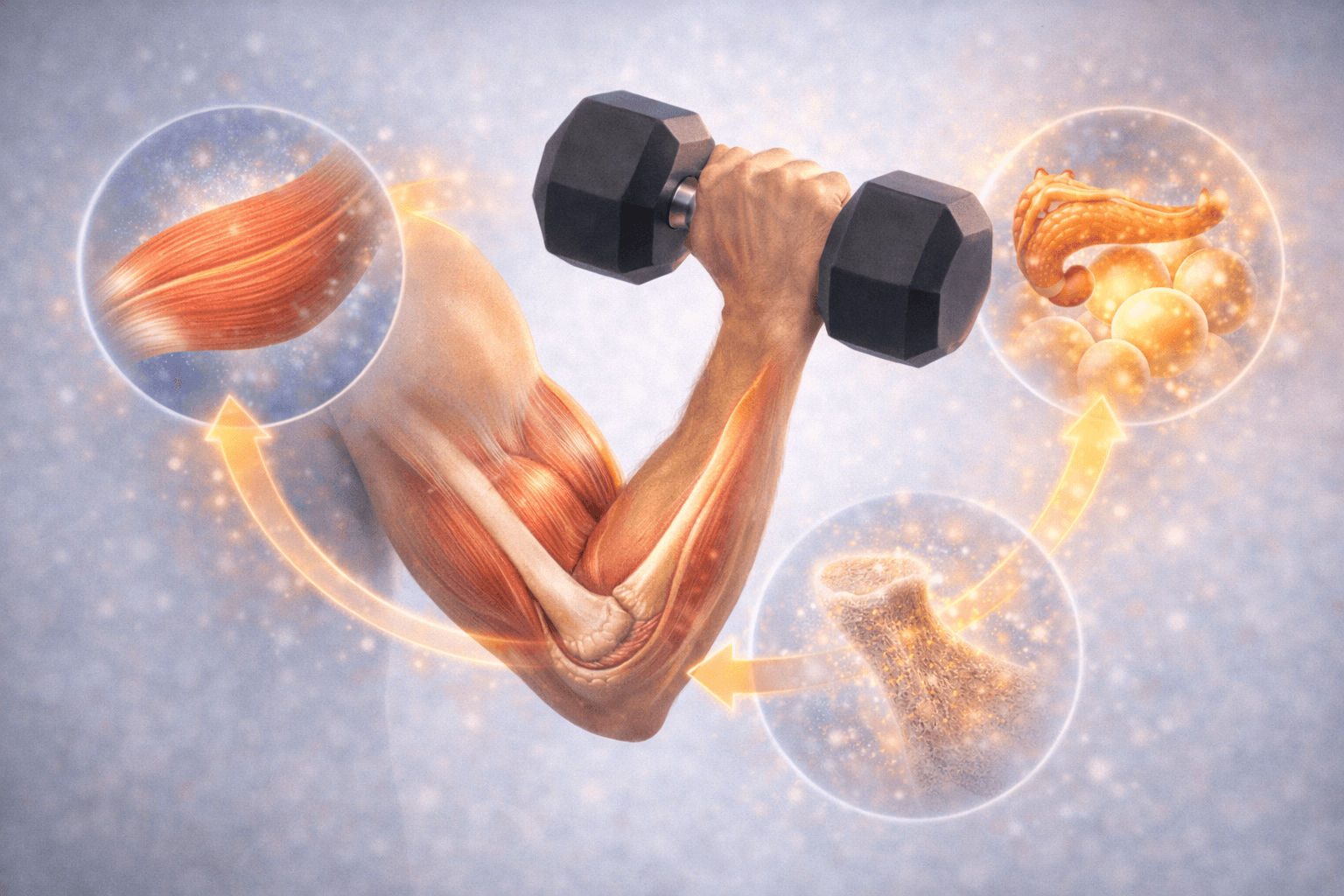
Why Muscle Mass Is a Longevity Asset
Skeletal muscle is the largest insulin-sensitive tissue in the body. Declining muscle mass — sarcopenia — accelerates metabolic dysfunction, increases fall risk, reduces functional independence, and is associated with worse outcomes from illness and surgery. The evidence connecting preserved muscle mass to longer healthspan is now robust enough that resistance training is included in most major aging and preventive health guidelines.
From a biological age perspective, muscle mass maintenance is one of the highest-leverage inputs you can control. It requires no supplements, no expensive equipment, and no advanced protocol — it requires consistency and progressive load over time.
How Muscle Age Differs From Cardiorespiratory Fitness
Both matter, but they age differently and respond to different training stimuli. VO2 max — peak cardiorespiratory capacity — declines at approximately 10% per decade from midlife. Muscle strength declines at roughly 1–2% per year from the mid-30s if untrained, accelerating after 60.
The important insight: both are trainable at any age. Resistance training studies show strength gains in adults into their 80s and 90s. The rate of gain is lower than in younger adults, but the direction of adaptation is maintained. Starting earlier creates a larger reserve to draw on.
Movement Patterns That Matter Most
Rather than focusing on specific exercises, think in movement patterns. These six categories cover the functional movement spectrum relevant to healthy aging:
- Squat pattern (goblet squat, bodyweight squat, leg press) — lower body strength and knee joint health.
- Hip hinge pattern (deadlift, Romanian deadlift, hip thrust) — posterior chain, back resilience, and hip function.
- Push pattern (push-up, overhead press, dumbbell press) — shoulder and chest strength, posture support.
- Pull pattern (row, lat pulldown, band pull-apart) — upper back strength, posture correction, shoulder health.
- Carry pattern (farmer carry, suitcase carry) — grip strength, core stability, and real-world functional capacity. Adjustable dumbbells like Bowflex SelectTech 552 or a set of resistance bands make home-based carry and press work accessible without a full rack.
- Single-leg work (split squat, step-up, single-leg deadlift) — balance, lateral hip stability, and fall prevention.
A 2–3x per week full-body program covering all six patterns is sufficient for healthspan benefit. You do not need to specialize or maximize volume to maintain meaningful adaptation.
Advertisement
Recovery Is Where Adaptation Happens
Training provides the stimulus; recovery is where the adaptation occurs. The three highest-leverage recovery inputs:
Sleep: Muscle protein synthesis peaks during sleep. Consistently sleeping less than 7 hours reduces adaptation rate and increases injury risk. This is not a minor caveat — it is the primary limiting factor for most adults.
Protein adequacy: For adults focused on healthspan, a target of 1.4–2.0g protein per kg of body weight per day is consistent with most resistance training literature. Distributing intake across meals (rather than concentrating it at dinner) may improve muscle protein synthesis. Thorne Whey Protein Isolate and Garden of Life Sport Organic Protein are well-regarded options with clean ingredient profiles.
Deload weeks: Every 4–8 weeks of progressive training, plan a reduced-intensity week. Deloads prevent accumulated fatigue, reduce injury risk, and often produce performance jumps the following week. Oura Ring Gen 3 and Whoop 4.0 can help identify when HRV and recovery scores indicate genuine readiness versus accumulated fatigue — useful for timing deloads with objective data rather than feel alone.
The Role of Cardiorespiratory Training Alongside Resistance Work
Strength-only programs miss the cardiometabolic dimension of healthspan. The evidence-based recommendation for most adults includes both:
- 150–300 minutes per week of moderate-intensity aerobic activity, or
- 75–150 minutes of vigorous aerobic activity.
Combined with 2–3 resistance sessions per week, this protocol covers the major pillars of exercise-based longevity. If time is limited, prioritize resistance training first (it is more commonly underdone) and use brief cardio sessions — brisk walks, cycling, or rucking — as accessible filler.
Evidence Limitations
Strength training evidence is strong for function and metabolic health, but anti-aging claims are often indirect. Outcomes differ based on adherence, baseline status, and recovery quality.
Related Reading
- Lower Your Biological Age in 2026: The Habits That Actually Work
- Biomarkers for Longevity: What to Track and What to Skip
- Policy context: Editorial Policy and Disclaimer
Sources & Citations
- ACSM position stands on resistance training.
- Peterson MD et al. Meta-analyses on strength training outcomes.
- Westcott WL. Resistance training and metabolic health overviews.
- Fragala MS et al. Older adult resistance training recommendations.
- WHO physical activity guidance.
- NIH resources on muscle mass, strength, and healthy aging.
- Phillips SM. Protein and training adaptation reviews.
- Clinical sports medicine reviews on recovery and load management.
This article is for educational purposes only and does not provide medical advice.
Frequently Asked Questions
How We Choose Sources
We prioritize peer-reviewed human evidence first, major public-health guidance second, and use trend reports only as supporting context. Read our Editorial Policy for full methodology.
Written by AgelessWorld Editorial Team
Reviewed by: AgelessWorld Medical Review Board
Publisher: inboundflow.in
Last reviewed/updated: February 28, 2026
Editorial PolicyAdvertising PolicyDisclaimer
Not medical advice. Consult a qualified clinician for diagnosis or treatment decisions.
Advertisement